MidiBUD is an AVR (ATmega328)-based MIDI processor device originally based on Mutable Instruments MIDIpal. It sits between a MIDI controller and up to 4 destinations, splitting and transforming each incoming note/CC stream per “scene” before re-sending it.
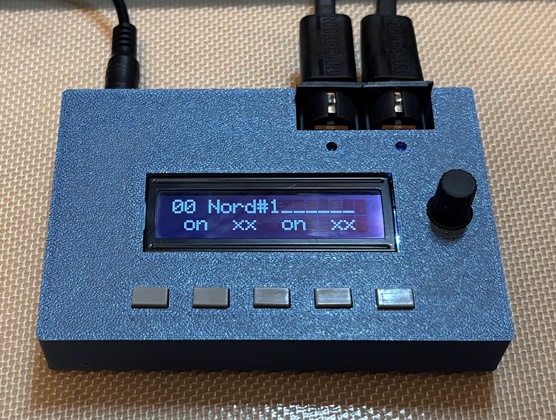
Hardware
- ATmega328 MCU, 16×2 character LCD
- Rotary encoder with push/click, 5 tactile switches
- MIDI in/out, standard DIN5, with activity LEDs
- External I2C EEPROM for patch storage
Programs and scenes
- Programs — up to 100 named presets stored on board, each with its own settings. Browse, load, rename, and save programs right from the front panel using the encoder.
- Scenes — every program has 4 scenes, and any combination of them can be active at once. Each incoming note is routed through every active scene in parallel, so a single MIDI input can drive up to 4 differently transposed, filtered, and re-channeled outputs at the same time.
Per-scene processing
Each scene can independently:
- Re-channel — send its output on a different MIDI channel
- Zone — only respond to notes within a set key range
- Transpose — shift notes up or down by up to 4 octaves
- Reshape velocity / aftertouch — apply one of 9 response curves (linear, soft, hard, wide) to note velocity and aftertouch
- Note hold — sustain/latch notes independent of note-off
- Filter event types — selectively block notes, aftertouch, control change, and program change messages
- Send bank/program change — recall a bank and program on the destination device automatically whenever the scene is switched on
Program-wide settings
Shared by all 4 scenes in a program:
- MIDI channel — the input channel the device listens on, or OMNI
- Scale-quantize — snap incoming notes to one of 86 built-in scales around a chosen root note, before they’re routed to the scenes
MIDI handling
Full MIDI message support: notes, polyphonic and channel aftertouch, control change, program change, pitch bend, clock/transport (start/continue/stop), and SysEx passthrough. In and out activity is shown on dedicated LEDs.
User interface
A 16×2 LCD display, rotary encoder with push/click, 4 buttons, and a shift button drive a page-based UI covering: program browsing/renaming, MIDI channel, root note, scale, and quantize mode for the whole program, plus per-scene note hold, transpose, channel, velocity curve, aftertouch curve, zone, filters, and bank/program change. A dedicated MIDI monitor page displays incoming MIDI messages live on the LCD for troubleshooting.
Full user interface details are available here.
Firmware
Firmware can be updated using MIDI SysEx, no programmer required, via the web page or by directly sending the SysEx to the device.
DIY Resources
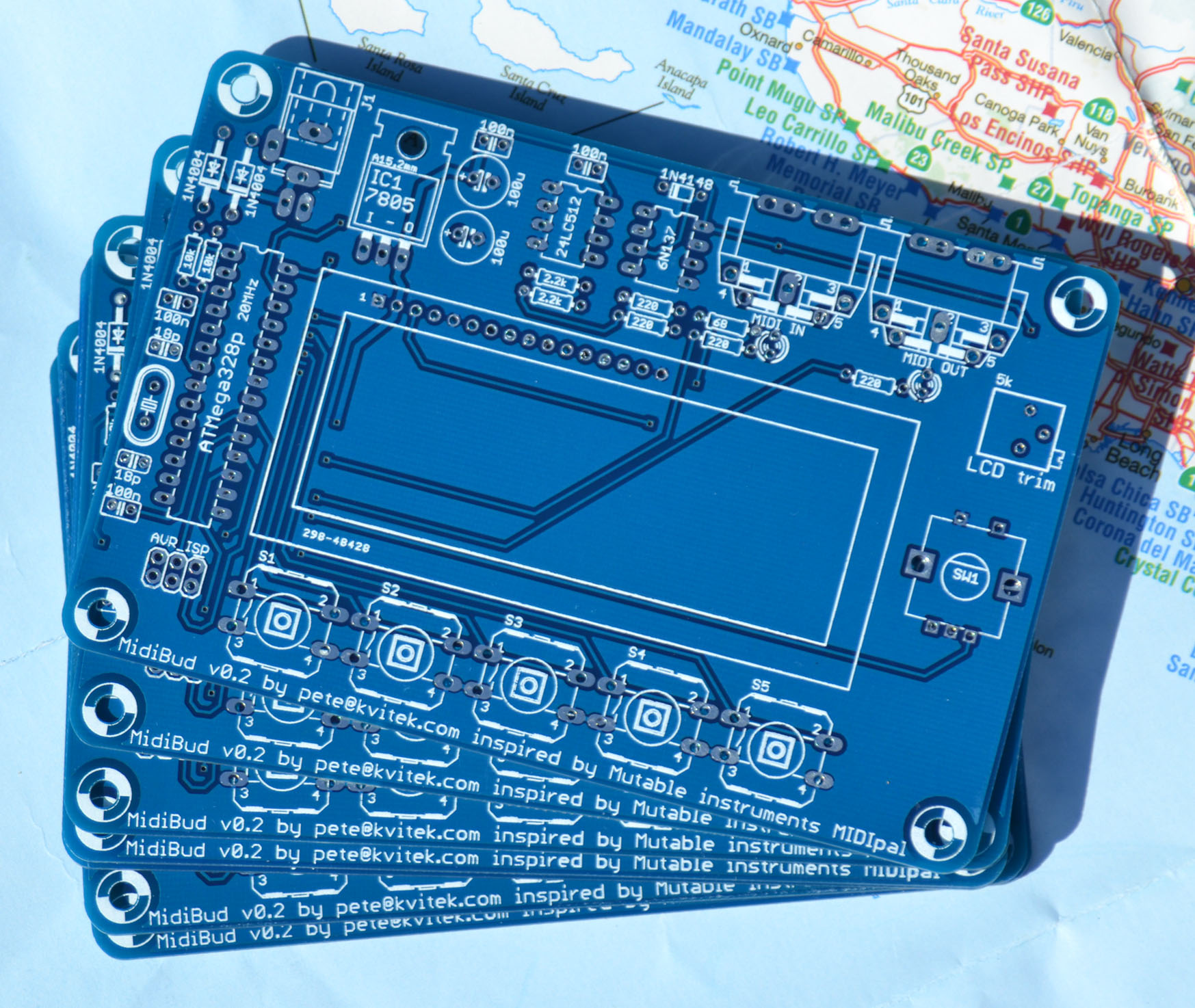
MidiBUD Eagle files.
MidiBUD schematics.
MidiBUD BOM.
Ordering
To order MidiBUD, please send an email to pete at kvitek c o m specifying how many PCBs and pre-programmed MCUs you need, a country where to ship them, and an email address to send the PayPal invoice to.
Prices (US dollars):
- MidiBUD PCB — $25
- Pre-programmed ATMega328p — $10
Shipping:
- Continental USA — $5 (California residents add 8.75% tax)
- Canada/Europe — $20 ($25, if pre-built or a case is included)
- Australia — $25 ($30, if pre-built or a case is included)
Please make sure your PayPal shipping address is correct!
If you don’t trust your soldering skills, you can order a fully assembled MidiBUD in a 3D printed case for $165 plus shipping.


Hi,
I have a MidiGAL – is it able to duplicate the functions of a MidiBUD? As they’re both derived from / inspired by the MIDIpal, I thought that the BUD was an earlier version, superseded by the GAL – is that wrong?
Steve
MidiBUD has 5 switches — 4 for scene selection and 1 acting as a shift key. These 5 switches are essential for live MIDI stream routing and control. MidiGAL has just one switch, so no, it cannot do things MidiBUD can.